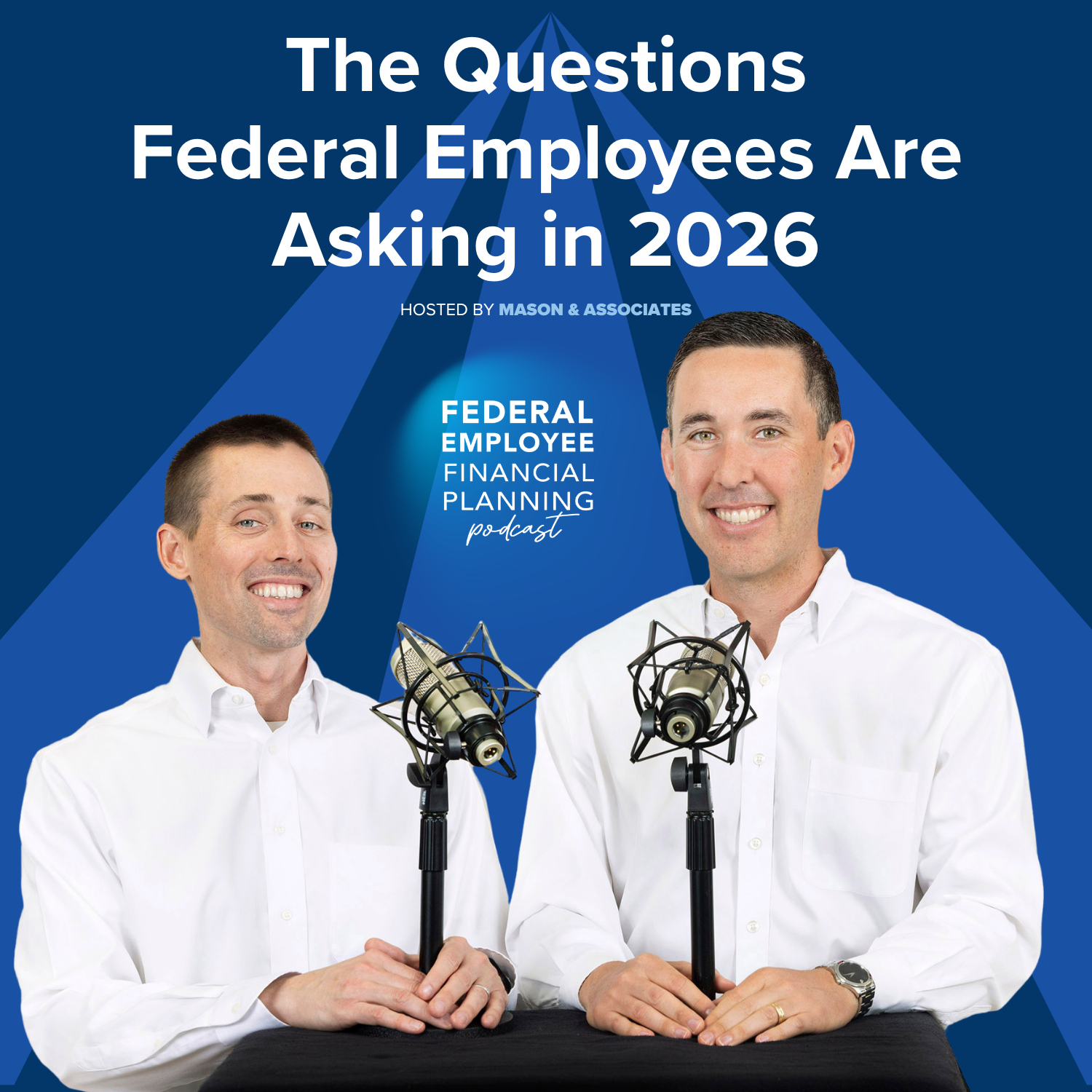
What really happens behind the scenes after 350+ client meetings in just six weeks—and what do those conversations reveal about how people are thinking about money, life, and the future? John and Tommy wrapped up their 2026 Strategic Planning Meeting season earlier this quarter, and in this episode, they are going over some of the top questions their federal employee clients asked.
You’ll learn what clients are prioritizing right now (from retirement income planning and tax strategy to spending philosophy, cybersecurity, and estate considerations) and how advisors are evolving their approach to better serve changing needs. The conversation also explores investment expectations in volatile markets, the balance between growth and spending, and why the firm is rethinking everything from onboarding processes to technology systems. Don’t miss this transparent look at how real financial planning decisions are made at scale.
Listen to the full episode here:
What you will learn:
- A Mason & Associates team update. (4:15)
- New client onboarding processes and procedures. (8:15)
- Common themes that were discussed during our client meetings. (14:00)
- How to approach investing intelligently. (19:00)
- What you need to know about cybersecurity now. (28:00)
- Different tax deductions that became available this year. (34:20)
- What to know about harvesting gains and losses. (43:00)
- The importance of having trust in your financial planner. (49:00)
Ideas Worth Sharing:
- “With big gains come losses. And when your account is going up 10, 15, 20%, we have to be ready for your account to go down 10, 15, 20%.” – Mason & Associates
- “There’s always crises. There’s always something to be scared of. That’s just part of the nature of investing.” – Mason & Associates
- “You need a portfolio that you can live with in good times and in bad.” – Mason & Associates
Resources from this episode:
Did you enjoy the Federal Employee Financial Planning Podcast? Never miss an episode by subscribing on Apple Podcasts, Amazon, Spotify, and YouTube Music.
Read the Transcript Below:
John Mason: Welcome to another episode of the Federal Employee Financial Planning Podcast. In this episode, we’re discussing the 2026 strategic planning meeting season. It was a successful season. We held over 350 client meetings. All meetings were about an hour long, and we have a summary today of the key talking points that we discussed, what clients were concerned about, some of the value-adds that we discussed during those meetings, and more.
In this episode, Tommy Blackburn and I are going to walk you through what it was like to be an advisor and a client during strategic planning meeting season. Again, this is a recap of the season that just ended before Memorial Day weekend.
Tommy, welcome to the Federal Employee Financial Planning Podcast.
Tommy Blackburn: John, great to be here with you as always. It was nice for us to get that long Memorial Day weekend after that fun but somewhat intense strategic planning meeting season we just went through. A lot of great recap information to share today, so looking forward to going through it with you as always.
John Mason: Well, it’s a wonderful six-week period that’s really more than six weeks, right? It’s actually more like 12 weeks or even 15 weeks as you think about… You execute the meetings for six weeks, but then you’re actually preparing for six to eight weeks beforehand. You’re reviewing tax returns as those come into Q1.
So, I mean, it’s a sprint, calling it out. It’s a sprint. January 15th through the end of May is just an absolute sprint, serving clients, bringing on new folks, and this actually gives me a lot of anxiety heading into June. We’re recording this May 27th. This is my most anxious period, audience, of the entire year because I don’t know what I’m supposed to do with my life tomorrow.
It’s been very clear how to keep busy the last five or six months. Now going into the summer, I have to be a little more diligent with my calendar. Tommy’s a lot more organized than I am, so a little anxious going into June, but very proud of our team, very proud of our clients. What a wonderful first five months of the year.
Proud of myself for running the Memorial Day Freedom Run. Mason sponsored again, three years in a row, Tommy, as I dropped over a minute on my time. I didn’t get injured. I’m not paralyzed this year, so I hit both of my goals there of running three years in a row, not getting hurt, and improving my time.
Tommy Blackburn: Well, not getting hurt’s gotta be the most important one because that’ll derail everything. So that’s kinda gotta be objective number one there. Myself had, we always like to kinda go to the beach, have a little fun weekend after the end of strategic planning meeting season. So that was a nice change and just some family time for us.
I’m not too big into the marathons or anything like that at this point in my life, but who knows what the future could hold. Not sure that I see that, but could be surprised. And John, I almost think you’re right, what you’re sharing with the audience. It is a sprint, and we are going into, this is not gonna be slow. I already know. The summer is not gonna be slow. It’ll be slower than the sprint we just came from, but I already know the things we need to get caught up on. You can see those, and you can see the goals that the business has and the infrastructure that we’re gonna continue try layering into place over the summer.
It’s not gonna be slow, and there’s follow-up, of course, from everything with clients that came out of strategic planning meetings. And I also think it’s okay to just embrace slower time every once in a while, ’cause that’s why you did the sprint, so that you could have some slower time. I think there’s some book out there that talks about being comfortable being bored and perhaps, although our team probably doesn’t want you bored because typically a lot of ideas come out of that, which keeps everybody, keeps everybody busy.
But looking forward to—and it’s looking forward to—a change in pace, but it’s definitely not gonna be a complete slowdown. There’s no way, just knowing everything that’s going on with the firm, all the good things that are happening, but a lot of work to continue to tackle.
John Mason: Well, I guess a couple announcements on the firm business, audience, so hang in there with us as we kind of announce what’s going on at the firm, and then we’ll dive into the meat and potatoes of the podcast episode today.
We’ve successfully hired two people, Kyle Eagle and Leah, who both started in Q1 and Q2. Both of our new team members are crushing it, which is exciting. We’ve hired a third member who we’ll be announcing to you shortly, who should start with us sometime in June. That’s another financial planner with a few years of experience and close to CFP credentials.
So successfully hired two, we’re gonna go ahead and say three people as of June 1st. So really excited to share that with you. We’re gonna put a pause on hiring for the rest of the year and probably pick it back up again going into 2027. Office renovation project kicking off somewhere between June 8th and June 15th.
We’re making more office space, that way we have room for these new team members. And, Tommy, you mentioned that it’s not gonna slow down. Well, it’s not, because when you have a successful business, you’re doing two things: you’re taking care of families, and you are running the business. You and I have both of those responsibilities right now.
And audience, everything’s breaking in a good way. Like Tommy just said, “I’m gonna go print these notes.” And I was like, “You can’t.” He was like, “What do you mean?” “Printer’s broken.” He was like, “What do you mean the printer’s broken?” It’s like, well, it’s seven years old. Just like our document management solution we picked seven years ago, and our CRM we picked seven years ago, and everything that we have in place right now we picked seven years ago.
In our surge debrief yesterday, Tommy, where we talked about… we just identified that essentially everything’s on the chopping block. I think the only thing that’s maybe sacred is Holistiplan.
Tommy Blackburn: Our tax projection, our tax planning program, yeah. And it’s not even sacred. I would say there’s—I don’t know that there’s sacred cows around here, so to speak. But that software, honestly, our financial planning software, RightCapital, certainly we will reevaluate it. But between the two of them, I feel like they try to keep pace with the times. And Holistiplan has certainly continued to be a very go-to for us. I think RightCapital has done a pretty good job as well.
John mentioned CRM, just for those who aren’t sure what that is, Client Relationship Management is what that is. So it’s kind of like the Rolodex, but more. It’s really the central everything: notes, tasks, workflows, all that goes into there. And we remember switching to it, the current one, about seven years ago, and it has certainly evolved, but there’s new offerings out there, particularly, yeah, just trying to enhance the client experience and make the firm more efficient and enhance the team experience.
So a lot of things for us to evaluate there. A couple other things, John, as you mentioned, a lot of great updates. We posted about this, but the firm crossed 500 million of assets under management, which is not the goal to just get to these asset under management metric numbers, but certainly a milestone nonetheless.
And I think we have the date out there on LinkedIn, and I can tell you today as of May 27th, this is still true that we went over 500 million. So from a compliance standpoint, if we need a date assigned to that number, there it is: May 27th, 2026, over 500 million, which was a cool, again, milestone. Means that we’ve just been having some success and like to think doing things correctly.
And John, there’ll be more on this—hopefully you’re not gonna mind me putting this out there—but it is, you know, we’ve been beta-ing it, and we’re continuing to roll it out, is the client, the new client process is evolving. So we think that we’re making some changes that will streamline it, cut out some steps so that maybe it can go quicker, if it makes sense for both parties, if we think we can go quicker and want to go quicker. So just changing some of that process to hopefully solve what you, our clients or prospective clients, are looking for, which a lot of times, like, the feedback essentially was, “We’d really just like to get to work instead of having this process take as long. Can we just start working?” And so that’s a new process that we’re fine-tuning.
John Mason: I like it, Tommy. Yeah, new client process and experience. We may take down some of those old episodes we’ve recorded. Largely, the client experience isn’t going to change. What may change is the length of time that it requires to become a new client, and specifically, what we’ve realized, audience, is that we’ve spent, you know, Mike and Ken, over three decades each, maybe almost 40 years now between them. Tommy and I are approaching 20 years in the business, and we’ve realized that sometimes when we present an initial financial plan, we actually are questioning, who’s that for? Is it for the client? Is it for us? Are we doing it because we need to prove how smart we are? Are we doing it because it’s extremely valuable for the client?
And there’s no doubt that a financial plan is valuable. But let’s face it, when you’re 57 years old thinking about retirement, Medicare at 65 isn’t really a hot-list topic that we need to be discussing at 57 years old. Social Security, maybe we hit on it, but that’s five years away, best case. So what are the things that we need to solve today?
So what we’re thinking as we launch this new process is, one, we want to be able to make it a little bit less painful, less time-consuming to become a new client. We wanna make sure that we’re focusing on the things that are most important to you today and allow us to address those other things in the future when they’re relevant.
Because, yes, we’re experts on all that stuff, but talking to a 52-year-old who’s retiring from the FBI about QCDs at 70 and a half, let’s just face it, that’s really not that productive of a conversation unless we’re just trying to kind of pound our chest or show how smart we are. So yeah, stand by for that. The new client process and experience I think is great. It’s very exciting, so hopefully we’ll have June, July be able to record an episode as we continue to fine-tune that.
Tommy Blackburn: Yeah, I love it, John. I’ll dovetail a little bit. I just want to say to the audience, the financial plan’s not going away in any of this. Again, it’s just here’s what we need to talk about today, and let’s get to work with it, what’s most important to you at 57, 52, 62, wherever you are in your life in the plan. As John said, maybe some of it’s for us. Maybe that financial plan is largely for us, but it’s still critical.
So it’s still gonna be there. It’s still gonna be a, “Here’s where we sketched out long-term.” We’re still keeping track of those QCDs. We’re still keeping track of Medicare, but we’ll bring it up either when you ask about it, when you want to go into those details, or when it’s time. But we don’t need to necessarily drag you through all of that in the beginning. It’s there. It’s supporting all of the analysis, the framework, the decision, kind of the blueprint that we work off of and evolves. Just when is it timely? What pieces of it are timely? When do we go into it? And for those who are very detailed and wanna see all of it, we’ll be more than happy to go through as much depth if and when you want to.
But it’s just, again, so the framework is not disappearing. I just wanna make that clear to folks. This is just hopefully the experience is being elevated.
John Mason: Wonderful. Let’s just say today is May 27th. We surge, or we do strategic planning meeting season where we only take care of existing clients because we get really good at it. It took us, like, 20 minutes to get ready for this podcast because we haven’t done it in a couple months. So we’re accepting new clients through the rest of the year. Yes, we would love to help the people you care about. We’d love to help you. Let’s go ahead and roll that commercial about the new client experience.
Commercial: Thank you for tuning in to another episode of the Federal Employee Financial Planning Podcast. Are you interested in moving from general education to personalized advice? You can start that process at masonllc.net. That’s masonllc.net. Or give us a call at 757-223-9898. If you’re not ready to take that next step, that’s okay. Keep hanging out with us right here on YouTube and our Federal Employee Financial Planning Podcast.
John Mason: Tommy, let’s dive right into the strategic planning meeting season. Audience, thanks for bearing with us for 12 minutes as we kind of just went on a couple tangents.
So 2026 strategic planning meeting season, let’s take a look at some of these stats. So, 354 client meetings over six weeks. Average meeting duration about 60 minutes. Client satisfaction very high. Advisors involved, we had six this year. So audience, what we did is we recorded probably 99% of these meetings with an AI note-taking service that gives us a summary of what we talked about. We get to review key findings from the meetings. It helps us draft things like summary emails. So we’re not hiding from the fact that we’re using AI, but we’re using AI to supplement the human touch of what we do at Mason. So some of these stats—all the stats that we’re gonna walk through today—was what our AI note-taking service was able to provide for us.
So 354 client meetings, 60 minutes. The note-taker says client satisfaction was very high. If you’re a client, hope that’s true. Consistent themes that we developed across the meetings—I’m just gonna hit all of these, Tommy: retirement income planning and Social Security timing; cash flow is king, we know that; tax planning under the new tax laws; estate planning and account organization; charitable giving; spending philosophy—I know this was a big one for me, we talked about the Bill Perkins book, Die with Zero; we had some clients talking about housing decisions, relocating; cyber security, which I think we should touch on cyber, I know we’ve done that in the past.
And what was very kind of—number eight is investment performance review and allocation, which is interesting. So I’d like to start there, Tommy, is I’m actually a little bit surprised to see this because we talked about investment performance very little, in my opinion, over the 354 client meetings.
Tommy Blackburn: Yeah. And I’m looking through our summary. I can roll with it, trying to see exactly. I would’ve thought maybe it’s the themes. I see. So investment performance review and allocation. So I think that did come up, John. It wasn’t, it was never the focus of a meeting, but I think that at least for clients that I was working with, a decent number of them would say like, “How are we doing?”
And to me that is a combination of, well, let’s take a look at the accounts just to, to show you again, because most of them would profess that, “I don’t look at it all the time.” And my read of that is there’s a lot of scary stuff and headlines that I’m seeing in the world right now, and I’m just not looking at my investment accounts ’cause I’m expecting—I’m a long-term investor and I’m expecting—I’m not gonna be happy if I go look at it right now.
So it was more of, hey, we don’t have a crystal ball. Things, there’s always crises, there’s always something to be scared of. That’s just part of the nature of investing. But right now the strategies have held up. Market is doing well. Let’s take a quick look, and even if that wasn’t true, let’s take a look and let’s just see where we are.
And then of course, let’s go back to the financial plan or let’s talk about your situation and that everything is working very well. Let’s talk about decisions that need to be made, whether that’s additional spending, whatever we’re wrestling with in life, let’s get back to what we can control. But there certainly was, and I think it’s just part of investments. Hey, let’s just do a quick look. Where are we at? There’s a lot, as always, to be afraid of. And so I think that was part of it, just kind of head-on address any of those fears if they showed up. And it was usually a quick conversation.
John Mason: I agree. Yeah, I just jotted down maybe less than five minutes per meeting was talking about investment performance. A lot of our clients have been clients since 2017, 2010. I mean, we have some clients that go back to like the early 1990s. Most of our performance data for our most tenured clients goes back to 2017 as of, that’s when we started with our current custodian.
So you look back to 2017 and you see these tremendous gains in the portfolio, and our software shows you net contributions that you’ve put into the account, so that’s additions and subtractions, so money in and money out. And then there’s the green line, which is your account value. And most of these, the blue line happened a few years ago where it maxed out, and now you’re actually seeing the blue line go down because clients are taking distributions, but the green line is still going up and to the right.
So I love that chart because our clients who are taking distributions, it’s like, look, you have—many people—more money than you did in 2021, and you’ve been taking distributions over the last four or five years, and you still have more money. So that makes people feel really good to see the blue line going down and the green line either going up or staying flat.
And we made sure to let our clients know, at least I know I did, and I’m sure you did as well, that yes, we do a good job managing the portfolio, but the market moves up and to the right more often than it doesn’t, which is why we kind of take the stance of stay out of the way. Broadly diversified, minor tweaks around the edges, low cost, let the market do its thing. It goes up and to the right. We’re not responsible for all of this beautiful stuff that’s happened, and we don’t want people to hire us for performance. We certainly don’t want people to fire us for performance. And this strategic planning meeting season continues to confirm that. So we have big gains because that’s what the market does. We’re staying the course. Distributions are happening. Account values are flat or growing.
I think one of the things that I know we talked about as an advisor team is we can’t tell you when the market’s going to go down, and audience, bear with me with these stats, but every year the market’s supposed to have a 10% correction. I’m pretty sure that happened in ’26. I know for sure it happened last year during tariffs. Every three years, the market’s supposed to go down 20. I don’t know if we— I think maybe we hit 20 last year, I think;
Tommy Blackburn: Yeah. As you joke, Judgment Day, also called Liberation Day. Yeah, I think the market was down, if not 20, it was really close.
John Mason: 2022, we were down right at 20%. So we’ve seen some volatility, and folks, we can all prognosticate or guess about what’s AI going to do. Is it a bubble or is it a boom? We don’t know. We really don’t know what’s going to happen. So buckle up. With big gains comes losses, and when your account is going up 10, 15, 20%, we have to be ready for your account to go down 10, 15, 20%.
There’s no free lunch in the world, which means if you like the volatility on the upside, you have to embrace the volatility on the downside. You gotta love both of it, which I know is counterintuitive, Tommy, but I think we did a good job discussing that with clients.
Tommy Blackburn: We do. And that’s where we kind of come back to the plan, which is, “Hey, we’re looking at this from both sides.” And even as a firm, we started the episode off by mentioning everything going on with the firm, and we do the same in our own planning, which is, “Hey, it’s great that the market’s doing well, client portfolios are doing well, but we’ve got to stress the firm as well to see that downside scenario just like we do with client plans, so that we can plan appropriately.” And that’s why we have the larger plan.
And John, as you mentioned, I too… One, it’s funny to hear you talk about blue lines, green lines, because I think perhaps you trained your—
John Mason: Is that the colors?
Tommy Blackburn: Yeah. I think it’s what you said, right? “I know there’s a blue line,” and then, yeah. And for you to say that, it’s like you’ve just trained yourself as to what those colors are.
The other part is I think about Die with Zero and the balance of spending for today with balancing longer term, which was a theme out of strategic planning meeting season. I think that chart you’re referencing is a good one too, ’cause I had several client, for that reason, several clients who said, “This is cool to see. Like, I’ve taken all these distributions, and our accounts have actually grown.”
So as I, Tommy and John, as I think about the warm hand, cold hand—giving it to people I care about or charities when I have a warm hand versus when I’ve passed and I have a cold hand, whatever the preference is—but like, I can see I’m doing these things in my family. I’m doing it with a warm hand, and still the accounts are growing. So that was a cool revelation to see. Granted, we could get a scenario where we have a down market and that flips. But most of the time, that’s actually what you’re gonna see. Most of the time the market goes up.
And the other one, John, is some of it was revisiting, just grounding back to the plan of we’re doing a really good job, client, of balancing spending for today. And you’ve actually, you’ve taken out a… we’re seeing that blue line. Your contributions are really going down, and your account has maintained its value, and that’s really cool to see that happen. But what that also tells me is that we’re really threading a needle of enjoying today, but keeping an eye on tomorrow.
Essentially, we can’t just… we need to maintain this level we’re at. We’re doing a great job of threading that needle because the market could go down, and we’ve got to prepare for that scenario as well. So it’s a really great, another great tool to walk through with clients. Not anything to do with, oh, how great are we with our investments, but just kind of reframing the bigger picture.
John Mason: Good call. So we’re gonna talk—I’m gonna talk a little bit about the Die with Zero warm hand, cold hand. Finishing up investment performance, too, is that… or investment conversation, is I had a good conversation with many clients who, when they became a client 10, five, 10 years ago, I didn’t have a kid, I had just bought a house, I didn’t have any of this gray hair, and they told me that they were gonna take distributions from their portfolio, that they would freak out if the market was down more than 15% or 20%. So we had them allocated a certain way to prevent all of that from happening.
So the conversation we were having was, “Mr. and Mrs. Client, 10 years ago, we designed a plan around all of these assumptions, and now look what’s happened. Now I have almost a seven-year-old. I’m covered in gray hair. You haven’t spent a dime from your portfolio. Everything has changed. You’re 10 years older. We have less sequence of return risk than we did before, and let’s just call it out what it is: your guaranteed income is doing everything it needs to do for you, and what we’re really doing is we’re probably investing this money for the next generation.”
So how do we, A, help them now? How do we, B, you know, not wait to give them a huge inheritance 20 or 30 years down the road, but can we at least think about maybe dialing this investment allocation from a 40% stock to a 60% stock? “Mr. and Mrs. Client, if you came to see me today and you asked my professional opinion on how you should be invested, we’d be starting the conversation at 60/40 and dialing up or down from there.”
And we’ve had a lot of clients who have said, “You know what? You’re right. We can take on additional risk because the difference between being down X and Y, we’re still unhappy either way.” And our plan works either way. Whether we’re down 15 or down 20, we’re unhappy. But if a 60/40 or a 70/30 can boost your returns by one, two, 3% or more over three decades, that’s certainly a lot more impactful than being down 5% or 10% more one year or two years, every 10, 10 years or so. So I think that was a really cool experience. Clients loved hearing about your warm hand, cold hand experience when you were on vacation, and…
Tommy Blackburn: It’s been humbling. Yeah, it has been humbling to get that feedback, and it’s one of those things that’s really cool to see a saying, a phrase have impact, not even just for our clients, but the folks our clients are interacting with. Absolutely love it.
And John, I think about as we’ve got some experience now, as you’ve referenced a few times, it’s interesting to have some conversation. I think John and I, hopefully tactfully and positively, both have pushed on some clients of, what is it you’re trying to accomplish? We know we don’t wanna be frivolous. You don’t want… would you like to leave an inheritance? And usually the answer is absolutely not. There are a few people who say, “Yes, that is a goal. Maybe I got an inheritance, and it’s been helpful and important, so it’s very important that is actually part of the plan.”
Most people, though, are almost adamant that, “No, whatever’s left over is left over, but there is no goal. I’ve worked for this money. I saved this money. I’m gonna enjoy this money.” And then John and I get to basically be a little combative of like, “Was that right? Because you’re gonna leave an inheritance. You keep telling me you’re not gonna leave an inheritance. You’re going to leave one,” because we’re watching this line go up and up and up, and I’ve done this long enough, I can tell, “You’re leaving an inheritance unless you change something today. So what are we gonna do about it?” And it’s just—
John Mason: You’re gonna have to work really hard not to.
Tommy Blackburn: Yeah, and some people, it’s like, “Hey, client,” they’re working hard. They’re taking trips. They’re doing these things, and they’re still watching their accounts grow. So it’s almost a little bit of can we be realistic here? You may not think you’re leaving an inheritance, but your behavior says you’re leaving an inheritance. So at least just sit with that, digest that for a little while as you think about the rest of your financial plan and how you wanna approach it.
John Mason: So in summary, what’s the purpose of what we’re doing, right? And I guess we did talk a lot about investments because we wanted to make sure that we’re investing appropriately for goals, and goals change over time, which again is the value of having that ongoing relationship.
And, like we said in the LinkedIn post, I had two goals or three goals with this Memorial Day Freedom Run. It was to beat my time from last year, and it was to not get injured. Not injured was the primary focus, not beating my time. During the race, I got to about mile three or four, and it became pretty clear that ChatGPT was a little bit overly excited about how fast I could run. And rather than try to beat an arbitrary benchmark that ChatGPT set for me, I just ran my own race. I was comfortable with my time. I could see on my watch I was gonna beat my time from last year, and I was completely cool with that. So thinking about your investments and the purpose behind things is we don’t need to beat an index just to beat an index because your friend told you or ChatGPT told you. You need a portfolio that you can live with in good times and in bad.
So switching to cybersecurity, I think we can just hit some quick hit items here. This was a theme. We always like to have a value-add, Tommy. More like a dedicated section to draw people’s attention to something maybe they haven’t thought about before. So we talked about this year things like number lock and SIM card lock through your mobile cell service carrier. We talked about freezing your credit. We talked about these new deed, D-E-E-D, deed alert systems where you can be notified if somebody’s trying to file a fraudulent deed on your behalf. Primary risk there is people who have paid off homes with no mortgage balance. These deed alert systems are pretty cool. I know in Virginia we have them, and many other states are having them too.
We talked about password managers, both from sharing among spouses, but also the estate planning piece where, you know, if mom and dad are lost at sea or can’t be found or have passed away, the son or daughter or executor can hit “they’re gone,” and there’s like a time constraint, right? It’s like within 72 hours if they don’t respond, the survivor gets access to the passwords. So there’s a lot of really cool stuff there.
And then Tommy, I know you’re chomping at the bit. With the transition from passwords to passkeys, I just feel like passkeys, at least my understanding, they’re stored on your device, and that’s one thing. But like, what if you want to log into the Blue Cross Blue Shield Medicare rebate site from three different things? Well, that’s three different passkeys. What if you don’t have the access to that? Well, a password manager can store those so that you have one passkey that you can share.
It just seems like all of cybers… and we also talked about hacks and how we watched an AI agent clone a human’s voice in like 30 seconds. So we had a lot of good conversation about preparing clients for the future and what they should expect, and if Tommy’s not blinking during his next meeting, that maybe they should be a little bit worried.
Tommy Blackburn: John, I love it. A few things I wanna say. One, I think we probably should do a newsletter around this topic. I think it would be helpful just to put it out there. A-and part of the thought process here is that we mentioned, hey, the new client process is changing, and while clients have a fairly similar journey and experience in the firm, just like when you’re a new client and we wanna focus on now what’s most important to you, it’s the same thing with the strategic planning meeting. So many clients we talked about these items with. However, there were many more immediate things that we were hitting on, and so this may not have always risen into the meeting just because we have an hour and we’re focused on all these other things, and we just didn’t get to it. So that’s where I think the newsletter w-will be helpful for everybody, both clients and prospects.
And those that we did talk about loved it. I… deed, the deed alert is cool. And also really, I threw in HELOCs quite a bit as I, I talked about that. We’ve been proponents generally of having a HELOC—Home Equity Line of Credit—if we’re gonna be responsible, which pretty much all of our clients are responsible anyway. They’re not gonna use it as an ATM. It’s just a tool for flexibility, liquidity, opportunity, very quick access to cash.
The other cool thing, though, as we think about deed alerts with a HELOC is, well, now there’s a lien attached to that deed, so that makes it pretty hard to change, and it also means a bank is now monitoring that deed. So, just another, you wouldn’t think about that on the surface, but another potential benefit of a home equity line of credit is a little bit of deed protection along with the deed alert.
And yeah, we as a firm, we do the SIM lock, so we do encourage clients to do that as well and make it harder for somebody to hack your phone. I think we lock our phone numbers down too, John, so that you can’t port those without those being unlocked. This all does create some inconveniences, ’cause you have to remember anytime you wanna change something with the phone, you gotta go do these things. It’s not impossible. It’s just like credit freezes of you just… takes a little bit of work, but it’s probably the right thing to do.
With credit, even if we’re not freezing it, I mean, there are so many opportunities now just on monitoring. I mean, I feel like every credit card or bank account I have now offers something where they’re like, “Here’s your credit score, Tommy. Here, we’re gonna send you alerts if…” Anytime I open up a credit card these days, John, I don’t know about you, but I feel like I get five alerts from whatever services I already have. So it’s pretty cool between freezing but also just the amount of monitoring that almost seems to be complimentary with many services these days. Again, things like just normal credit cards I have and even bank accounts saying, “Hey, Tommy, somebody just did this. Was it you?”
Theme there where I’m going is we can’t put our head in the sand. So we have to be aware of these. We have to have some strategies in place, and I think it is all very well received. I agree with everything you said, and I think it’s worth just recycling or just resurfacing almost as its own standalone newsletter.
John Mason: Thank you, Tommy. We’re gonna do a quick commercial break as we talk about our new e-book on survivor benefits.
Commercial: We’re excited to share with you that our e-book on survivor benefits is now live on masonllc.net. Yes, that’s right. The e-book on survivor benefits is now live at masonllc.net. There’s a banner. We ask for your email address, and then we’ll send you that copy. We take your email address very seriously. We promise we will not spam you. We’re not going to inundate your mailbox. But once you sign up for that e-book, we will send you our monthly newsletter campaign to keep you updated on what’s going on at Mason & Associates.
Folks, if you like this e-book, you can be somebody’s hero. Share it with somebody who’s about to make one of the worst decisions, which is declining survivor benefits. We’ve built a business since the early ’90s helping federal employees, military, and state elect full SBP at retirement. We think that this resource is invaluable, and you can be somebody’s hero by sharing it with friends, family, and coworkers to prevent this life-changing mistake.
John Mason: Okay, Tommy, so let’s dive into the next theme of strategic planning meeting season, which is, I think we can just like loop in here charitable giving strategy and tax planning as one, one kind of bullet item. Tax planning is always something that’s very important to us and our clients. It’s where we believe that we—well, we know we can quantify the value that we’re adding. We know that clients love getting a refund or liability that is something they expected. We’re not perfect. Sometimes refunds are a little bit bigger, sometimes liabilities are a little bit bigger. But we have a beginning-of-year and end-of-year tax projection for probably 99% of our clients. We know what to expect on the return. We review the returns, and clients absolutely love not being surprised. So I think that’s one thing to hit on.
But then this year, I know something that was very important that we wanted to address with everybody is, under the new one big beautiful bill, we were able to share the new $2,000 charitable deduction for married filing jointly that does not require an itemized deduction. So, that was welcome news to a lot of our clients.
Tommy Blackburn: Absolutely, because many folks are giving, but they’ve gotten out of the habit of tracking it just because they knew they were on the standard deduction, under tax law from 2017, the standard deduction got larger and larger. So it was just kind of a heads-up of, “Hey, you probably are giving and not keeping track of it. Maybe keep track of it because you’re, you could get this $2,000.” But you could see a lot of people thought, “Oh, that’s nice because yeah, I do, and it’d be nice to get a deduction from it.”
It’s interesting, a little bit of like the tax nerds in us thinking about as we look at itemized—so with charitable, there’s now a 0.5% haircut, so to speak, of, so if we are itemizing, say, “Hey, I gave $10,000,” take 0.5% of your income, and let’s chop it off. So let’s say it was like a $1,000 was 0.5% of your income, and well, now you get $9,000 for your itemized. And then there’s a calculation that thankfully we have good software to help us with this that says, “Well, actually, we’d be better just at that point, after we take that into account, of sticking with the standard and taking that new $2,000, even though we don’t get that full nine.” So it’s interesting to kind of look, you know, what’s actually the optimal answer here.
John, you don’t see this a lot, but it was a lot of interesting things with itemized this year. Many clients, because the SALT cap was removed, I was surprised by how impactful that was for many folks, where they were maybe just inching over itemization now between their state and local real estate, personal property taxes, plus now some charitable giving, and if they had a mortgage, surprising to see some of that impact.
And some clients, we had some fun planning conversations around, well, do we accelerate our state and local income taxes because it looks like we’re gonna be stuck at the standard deduction, but maybe if we try to bunch them all, just like we talk about with charitable giving, maybe we try to bunch it into one year? And we talked about some of the nuances around that, particularly around like real estate taxes. The tax has to be assessed. We can’t just be prepaying it. So there are nuances to be aware of, but maybe if we do this proactively and we even bunch some charitable, perhaps we itemize. And that was some really cool, fun tax planning to look at when it was applicable.
And there’s, as always, John, as I’m sure we all talked about, many of our clients looking at things like Roth conversions can be hugely impactful in the right situations. Many times, qualified charitable deductions or distributions—I’m sorry, QCDs—are just as powerful as ever. So that’s those tax-free distributions from an IRA to a charity at 70 and a half or older. Yeah, we spent a lot of time tax planning. We can go more and more into it, John. I’ll throw it back at you.
John Mason: We have the new 60 to 63 enhanced senior catch-up. We have in-plan TSP Roth conversions that we talked about. You mentioned donor-advised funds, QCDs—or you didn’t mention donor-advised, that was not a huge theme of the year, but we still have clients that have donor-advised funds or that maybe would want to consider it specifically for bunching those contributions or exceeding that 0.5 threshold one time.
You mentioned SALT. That’s the State and Local Income Tax. Previously, that was capped at 10,000, and now that being raised to 40 really is allowing people to get above and beyond standard. And also clients are relocating, which according to our AI note-taker, was something that we talked about with people. So now people are relocating, moving from a 2% or 3% mortgage to a 5% to 7%, depending on when they purchased the house and what rates are. Now all of a sudden, a million dollars at 5% is 50 grand in interest. You pair that with the state and local income tax deduction that goes up to 40,000, it’s not completely crazy to see some pretty large itemized deductions now.
And so again, things change. Plan evolves, tax plans change, not only because the law changes, but because people’s, yeah, actual life changes. So it was cool to see all of that, and we love tax planning. So, and even things like, do you do QCDs for $2,000 at 70 and a half, or do you just do a cash gift of $2,000 at 70 and a half? So just being able to have that conversation too on what’s more efficient for everybody. At 73 or 75 when they start forcing out those RMDs may be a different story, but there’s just no, like, right answer to some of this stuff.
Tommy Blackburn: There’s not. And of course, you mentioned RMDs, QCDs also makes you think about things like IRMAA, those Medicare success taxes. So yeah, a lot of things that can go into a tax projection depending upon where we are in your plan, in your life cycle. We had a lot of folks retire. That’s what we do a lot of is help people retire and stay retired. And it was, as always, a lot of that this year.
And John, what I’m thinking about here is some folks, probably newer relationships, yeah, a little bit of an epiphany. Maybe it’s because we don’t show you everything until we think it’s applicable or it’s time to kind of get into it. But some folks are like, “Hey, what about my taxes, now that I’m retiring, and how’s that gonna look? What are we doing? What’s withholding? I’m really worried I’m gonna owe with this adjudication that’s happening.” All the concerns.
And then pulling up a Holistiplan, pulling up the tax projection and saying, “Well, here’s where you were last year. Here was your tax return, what we noticed, any observations, and here’s where I’ve got you right now and what I think it’s gonna look like. And maybe even here’s a thought of what maybe something proactive we’ll do depending on what happens.” And I just remember the epiphany from one of the clients saying, like, “So you guys are looking at this all year, every year?” I was like, “Yes. Yes, we are. Like, you don’t need to worry about it. I’m happy to go through this, but it’s…” We take it for granted. We know we’re doing it, and it just kind of made me stop for a second and say, “Oh,” like they don’t always realize we are proactively running this in the background and surfacing it when applicable.
John Mason: It’s not uncommon to have three years of projections all on the same screen in Holistiplan, right? So you have a 2025 projection that you’re reviewing the 2025 return. You see that Joe and Sally are retiring in June, so you have a 2026 projection with a retirement midway through the year. You’re gonna make a withholding adjustment that makes it right for ’26, but then I’m always looking—and I know you are too—is what withholding adjustment am I making now, and is that gonna serve me well into 2027? Because I also only wanna make one adjustment if I can. So sometimes we’ll do a 2026 tweak that fixes ’27, but maybe leaves us a little bit short in ’26. Rather than making two changes, maybe you just make an estimated tax payment to fix this year.
So, it’s a push/pull. We’re advising on what source that we wanna have taxes withheld. Typically, it’s not Social Security. Typically, it’s something like DFAS or an OPM pension, or we’ll do it on an IRA distribution, or a required minimum distribution from, like, an inherited IRA. So, and I know we also talked about this year—and we should probably jump to the next topic—but harvesting gains, rebalancing portfolios. We have some clients who are delaying Social, where we can harvest gains at a 0% tax bracket, or even a favorable 15. So trying to weigh the Roth conversion versus harvesting capital gains and what you do with that. I know we have some clients where we’re kind of doing both. You harvest some gains, and then you do a Roth conversion on top of it.
We don’t have a lot of these right now, but as a public service announcement, if there are losses in your account that you have not harvested, it may be a good idea to look at harvesting those. Could be some bonds or fixed income or a bad investment choice. But it’s also to remember, Tommy, that if you die with capital losses, they just go away. So harvesting losses before death is pretty important.
Tommy Blackburn: These are all great, John. Yeah, and hopefully our audience bears with us. We know this episode is running longer than we usually strive for. It’s probably gonna continue to run, but we’re unpacking an entire strategic planning season here, and it’s a little fun for us. And so John, I agree, and the tax loss harvesting is, you’re right, we don’t wanna necessarily die with those. We also don’t wanna recognize gains. Unfortunately, we’ve seen some of that come to fruition with clients where we generally are tax efficient, period, and try not to realize gains unless there’s an opportunity like a 0% bracket like you’re talking about, John.
But people pass, and then you get a step up in death, or a step up in basis from death, so we’re watching for that. We’re also making sure we don’t leave losses unrecognized ’cause we lose those. Tax loss harvesting, I remember talking with a client where they have a brokerage account outside of us that they’re managing for whatever reason, and they’re like, “I’m thinking about doing these things, Tommy. What do you think?” I said, “That makes sense to me. I agree.” Well, when I—and of course, thank you, client, ’cause now I can bake in a capital gain into your tax projection, so we’re all working together here. Said, “Well, I was wondering if you could work some of your magic, Tommy, and, in the past you’ve been able to create some losses.”
It’s like, well, we’re very tax efficient, so we’ve been working around the gains as much as we can because they’re not in a low-tax situation. And it’s like, look at the portfolio with me here, client. We’ll pull it on screen. There are no losses for me to work with. So, to your point, John, that was just anecdotally. It’s like, there’s nothing I can do inside of the brokerage account we’re managing for you this year. Otherwise, we would. But I love it ’cause it’s just the dynamic nature as we go through time and looking at all these variables to figure out what’s right in your situation, and no two clients’ tax plan is exactly the same.
John Mason: So maybe another public service announcement for non-clients would be, you know, did you get a massive surprise on your 1099 consolidated on your after-tax brokerage account? Were there gigantic capital gains? Were there capital gains even though you didn’t sell anything? It’s like, well, what do you own in that account? Well, from experience, we can tell you that non-qualified accounts are the hardest accounts to manage because every trade you make matters. Every interest or dividend payment hits your tax return. So we need to think about municipal bonds or corporate bonds. And just because it’s a non-qualified account doesn’t mean you should automatically be in munis. If you’re in a tax-managed strategy somewhere else, that might just mean muni bonds.
Is this portfolio just rebalancing for you every quarter and incurring capital gains just for the heck of it? That doesn’t sound very tax efficient or tax managed to us. Also, do you own mutual funds that have a high turnover ratio or that kick out large capital gain distributions, whether or not you sell? Well, we can maybe eliminate some of that through an ETF rather than a mutual fund.
So public service announcement is, there is no reason that your non-qualified brokerage account must match exactly to how you’re managing your IRA or Roth IRA. They’re completely separate. We know that most firms don’t look at them completely separate, and they just hit the rebalance button every quarter, and they don’t care about the tax ramification. Maybe that’s strong, but let’s just say they don’t care what the tax ramification is or will be, or they’re just not… that’s just not the service that they provide. So that’s just a public service announcement to understand that it’s okay for your large-cap brokerage account that’s all growth stocks to be there because that’s what’s run the last decade, because we’re managing around the other accounts and you’re not overly risky in that particular account.
So Tommy, we need to wrap this, so I’m just gonna do real quick: retirement income planning and cash flow was important. We helped several clients apply for Social Security and Medicare, either during our meeting or scheduled a separate meeting. Audience, if this sounds like, “How did you cover all this in an hour?” It was a lot. And maybe you’re thinking, “Do we only get one meeting a year for one hour as a client?” The answer is no. We have guaranteed we need to do at least that. But if you have more concerns or more things that need to be addressed or more things that need to be implemented over the course of 2026, we’re gonna have as many meetings as necessary to do it. We’re not gonna force you to meet with us every quarter, but we are going to have the necessary number of meetings to either deal with life when it happens or make sure that we are implementing all the things that need to be implemented.
So that was retirement income and Social Security. Quick on estate planning, Tommy and I—Tommy, we went on a rant a few episodes ago about trust becoming a revocable trust. That’s the conversation we have with clients. It was like, “Guys, you need to go review those documents. You need to make sure they’re current. We need to review beneficiaries. And oh, by the way, if you’re gonna be the executor of your parents’ stuff and asking me for help, we need to start getting this in order now. And oh, by the way, I’m gonna be here to pick up the pieces when you or your spouse dies. It’s time that we consolidate all external accounts that we’re not managing with Mason, because when you die, me and your surviving spouse, that’s one less thing that we need to do. And oh, by the way, we serve you better when we’re managing everything anyhow.”
So I know that’s quick, Tommy, on, on those topics. I wanted to hit just a few other stats here on what were clients most concerned about according to our AI. It’s interesting: running out of money in retirement. Nobody wants to run out of money, which is federal employees don’t typically do that because you have great guaranteed income. I don’t think that we’ve ever had a client run out of money. Maybe we have. Not that I’m aware of. Social Security being cut or disappearing was interesting. Healthcare costs—certainly Blue Cross Blue Shield and Medicare and long-term care; volatility a little bit; caring for aging parents. We know that millennials—I’m sorry, boomers can find themselves in a position where they’re the barbell generation taking care of aging parents and maybe Gen X or millennials failure to launch or who are having a difficult time in this job and economic environment. So that’s an interesting little tidbit there. Job security, AI disruption, general uncertainty amongst the federal government, our debt, our spending as a country, making sure that they don’t leave a tip to the IRS. So these were the things that all kind of hit moderate to high on the list, with running out of money and Social Security being the two main drivers that looked like of concerns, followed by healthcare and then volatility and care for aging parents.
So, whew, what an episode.
Tommy Blackburn: Yeah. And the truth is we could keep going or break this into many different episodes, kind of tackle each topic more in depth if, if we wanted to. But enough of, hopefully, a very good recap, summary, just glimpse for those who are our clients and just getting a quick update, and maybe we didn’t talk about it in your meeting because it wasn’t as applicable. It gives you some insight into the larger amount, but as well as for those who are listening who aren’t clients, a lot gets discussed in these meetings. And it’s fun. It is fun. It is intense.
I think that some of that is where expertise truly shines because we joke that you can go in as prepared as… and you need to be. You certainly need to be prepared. But things, you go in all these directions that you don’t always anticipate, and so being able to move on the fly and also just bring like, “Hey, I’m having dozens of these conversations,” and that’s all top of mind and being able to share that amongst everybody in a timely fashion. It’s just a lot of value all around.
John Mason: It’s a fun time of year, man. Fun time of year. Mike Mason says, “I’ve got another 17 family reunions this week, every week for six weeks as we get through strategic planning meeting season.” So Tommy, thanks for another—oh, go ahead.
Tommy Blackburn: John, I know you… and sorry to derail us for a quick moment, as I was thinking about ’cause Mike and the 17 meetings, I just want it to be hopefully helpful to folks too. Even when we’re in this intense period, we still have some flexibility in our calendars. Now, we leave it, we really try to guard that so that we’re bringing our best selves to our client meetings and for things that pop up.
And I think about, I had an example where somebody we met, and then all of a sudden a real estate opportunity opened up and timelines were compressed. We needed to talk, so there was a lot of email communication, and there was a meeting or two that were fit during my lunch hour, essentially my kind of my overflow of, “Hey, we need to meet.” So I just want folks to… I think it’s valuable to know that, right? Most clients are very respectful, and these ones were as well that I’m thinking about. We know you, you don’t have a lot of flexibility right now, but when we need to meet, we’re gonna find time for the communications to happen.
John Mason: Taking care of our existing clients is our primary responsibility, and if that means we’re gonna stay in our box, we’re gonna do what we can, clients are very respectful of our hours. But if we need to go outside of normal business hours, if we need to get things done, if we need to make a phone call because something’s a 911 when we’re on vacation, we make it happen. Luckily, in our business, luckily with most of our clients, there are not many 911s that happen over the course of a relationship.
But I agree, Tommy, we’re effectively on retainer. Clients need to know they have access to us throughout the year. When life happens, we should be one of the top two or three people that get called instantly, and the last thing we ever want is somebody to struggle or go a year not making progress, stressed out, frustrated about something that we could have answered in five minutes because they didn’t wanna bug us. Clients, bug us. That’s what we’re here for. Pick up the phone, give us a call, shoot us an email. That’s what we’re here for is to help you. Please don’t go a year struggling through something without letting us know what’s going on.
Tommy Blackburn: And John, that’s also why we’re growing the firm is because there’s a limit as to how much time there is in the day and how much John, Tommy, Mike, Ken, Ben can handle, right? And so that’s why we’re also bringing additional resources to bear so that the best service is available to you, whatever the circumstance may be.
John Mason: I love it, Tommy. Thanks for another good episode.
Tommy Blackburn: Thank you, sir. It’s been a lot of fun.
John Mason: Audience, please do all the things for us: like, subscribe, hit the bell notification. As important, like we said earlier, you can be somebody’s hero by sharing this content and all of our content with friends, family, and coworkers across the country. We are growing the firm both internally and externally, which means we’re hiring new team members and we’re accepting new clients, and we’re honored that you continue to be here with us every two weeks on our podcast, that you continue to be available and sharing your time with us on our YouTube channel as well.
Remember, we’re financial planners first, we do this second. We hope you leave this episode and every episode feeling educated and empowered to make positive changes in your financial plan. Again, thank you for hanging out with us on another episode of the Federal Employee Financial Planning Podcast.
The topics discussed on this podcast represent our best understanding of federal benefits and are for informational and educational purposes only, and should not be construed as investment, financial planning, or other professional advice.
We encourage you to consult with the office of personnel management and one or more professional advisors before taking any action based on the information presented.